

When choosing a snow blower, one of the most important decisions is the power source: battery or gasoline.
Battery-powered snow blowers have become significantly more capable in recent years, while gas snow blowers remain popular for heavy-duty applications, large properties, and demanding winter conditions. Current product testing and industry comparisons show that modern battery models can compete with gas models in many residential applications, although gasoline machines still have advantages in certain high-load situations.
For homeowners, the decision usually comes down to convenience, power, noise, and maintenance. But for wholesalers, importers, retailers, distributors, and private-label brands, there are additional factors to consider, including product positioning, operating costs, battery platform strategy, shipping requirements, after-sales service, and target-market demand.
This guide compares battery vs gas snow blowers and explains which option may be better for different applications and B2B markets.
Battery vs Gas Snow Blower: Quick Comparison
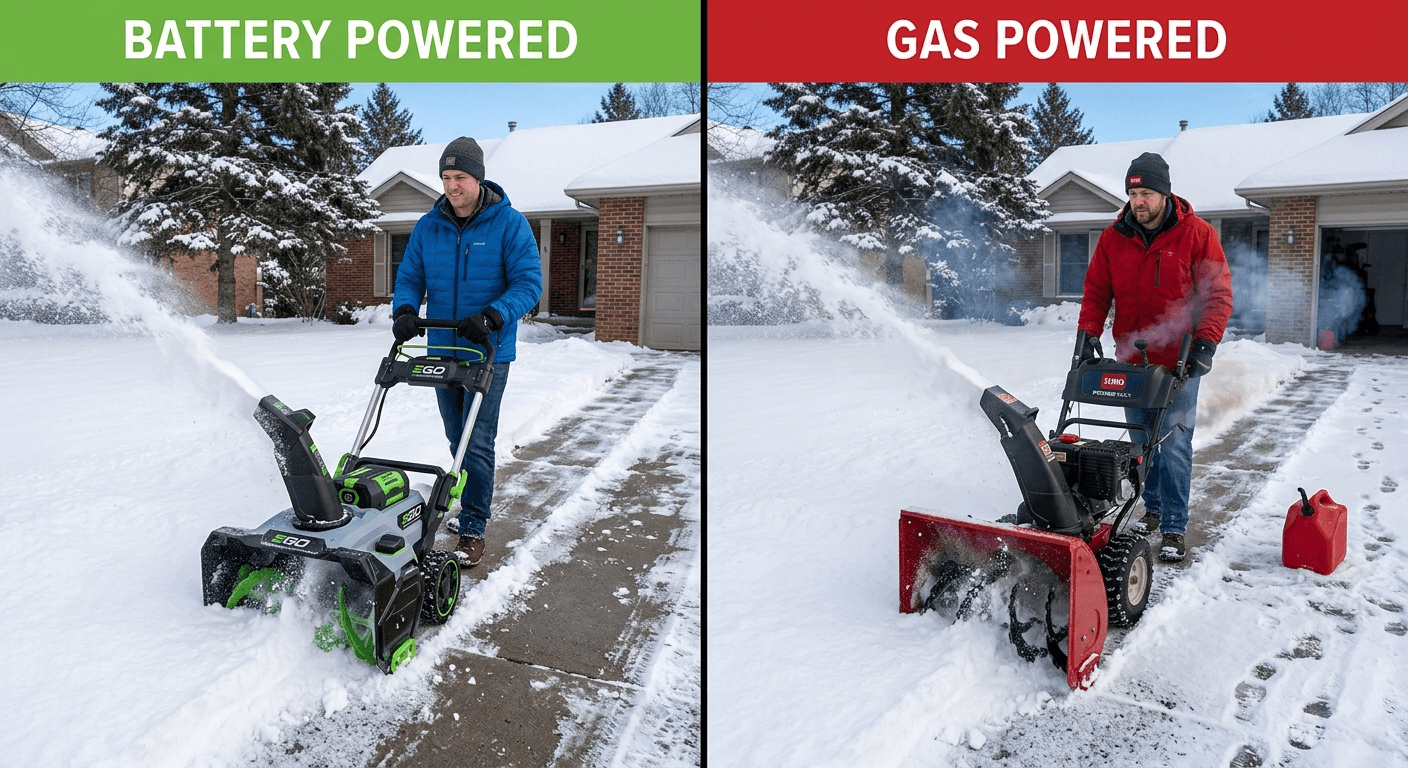
Before looking at each category in detail, here is a general comparison.
| Feature | Battery Snow Blower | Gas Snow Blower |
|---|---|---|
| Power source | Rechargeable battery | Gasoline |
| Starting | Push-button / electric start | Recoil or electric start |
| Noise | Generally quieter | Generally louder |
| Maintenance | Low | Higher |
| Fuel handling | No gasoline required | Requires gasoline |
| Operating emissions | No tailpipe emissions during operation | Produces exhaust emissions |
| Runtime | Limited by battery capacity | Refuelable |
| Heavy wet snow | Good to excellent depending on model | Excellent |
| Large properties | Suitable with larger battery systems | Excellent |
| Storage | Generally easier | Requires fuel and engine maintenance |
| User convenience | High | Moderate |
| OEM opportunities | Strong | Strong |
| Best market positioning | Residential, urban, premium eco-conscious | Heavy-duty, commercial, traditional OPE |
The important point is that neither technology is universally better. The right choice depends on snow conditions, property size, machine configuration, target customer, and product positioning.
1. What Is a Battery Snow Blower?
A battery snow blower uses a rechargeable battery pack to power an electric motor that drives the auger and, depending on the design, the impeller.
Modern cordless snow blowers commonly use lithium-ion battery systems. Some compact models use a single battery, while larger machines may use two or more batteries to increase available power and runtime.
Battery technology has improved considerably, and current models can handle substantially more snow than early-generation electric snow blowers. Some modern cordless models are available in both single-stage and two-stage configurations.
Key advantages of battery snow blowers
- Quiet operation
- No gasoline or engine oil
- Easy starting
- Lower routine maintenance
- Convenient storage
- No fuel mixing or fuel storage
- Suitable for residential neighborhoods
- Strong potential for private-label products
For many homeowners, these advantages make battery snow blowers particularly attractive.
For B2B buyers, battery models also create opportunities to develop a broader cordless outdoor power equipment platform, allowing batteries and chargers to be shared with other compatible products.
2. What Is a Gas Snow Blower?
A gas snow blower uses an internal combustion engine to generate mechanical power.
Gas-powered machines have traditionally dominated the snow blower market because gasoline engines can deliver high sustained power and allow operators to continue working simply by refueling.
They are particularly suitable for:
- Large driveways
- Long private roads
- Commercial properties
- Heavy snowfall regions
- Wet and dense snow
- Deep snow
- Packed snow
- Snow pushed into hard piles by municipal plows
Gas snow blowers are also commonly available in larger configurations, including wide two-stage machines designed for demanding applications.
For commercial users and customers who regularly deal with heavy snowfall, gasoline remains an important product category.
3. Battery vs Gas Snow Blower: Power and Performance
Power is often the first question buyers ask.
Traditionally, gas snow blowers had a clear advantage in high-load applications. However, modern battery systems have narrowed the performance gap considerably.
The actual performance of a snow blower depends on much more than its power source.
Important specifications include:
- Motor or engine output
- Auger design
- Impeller design
- Clearing width
- Intake height
- Stage configuration
- Battery voltage
- Battery capacity
- Drive system
- Snow density
- Operating temperature
A well-designed battery snow blower can perform extremely well in normal residential snow conditions.
However, when the application involves deep, wet, compacted, or heavily piled snow, a high-powered gas two-stage machine may still provide greater sustained capability.
B2B takeaway
For manufacturers and brands, it is better to avoid positioning battery products simply as “gas replacements.”
Instead, position products according to their intended application:
Battery snow blower:
Quiet, convenient, low-maintenance snow removal for residential and light-to-medium-duty applications.
Gas snow blower:
High-power snow removal for heavy snow, large properties, and demanding commercial applications.
This positioning strategy helps distributors target different customer segments instead of forcing both technologies into the same category.
4. Battery vs Gas Snow Blower: Runtime
Runtime is one of the biggest differences between the two technologies.
A gas snow blower can generally continue operating as long as sufficient fuel is available. When the tank is empty, the operator can refuel and continue.
Battery models are limited by battery capacity.
Actual runtime varies significantly depending on:
- Battery capacity
- Motor power
- Snow depth
- Snow density
- Clearing width
- Temperature
- Operating speed
- Auger load
Heavy, wet snow can require considerably more power than light powder snow.
For larger properties, B2B customers should therefore consider whether the product supports:
- Dual-battery operation
- Multiple battery packs
- Fast charging
- Spare battery availability
- High-capacity battery options
A battery snow blower with interchangeable batteries can be especially attractive for professional users.
5. Battery vs Gas Snow Blower: Maintenance
Maintenance is another major advantage of battery technology.
Gas engines require regular maintenance and fuel management. Depending on the engine design and usage, maintenance may include:
- Engine oil changes
- Spark plug inspection or replacement
- Air filter maintenance
- Fuel-system maintenance
- Fuel stabilization
- Carburetor-related service
- Seasonal preparation
Battery snow blowers eliminate many of these engine-related maintenance requirements.
Their typical maintenance needs are more focused on:
- Auger inspection
- Shear pins or mechanical components
- Drive components
- Battery condition
- Charger condition
- Cleaning and storage
This makes battery snow blowers particularly attractive to consumers who want a simpler ownership experience.
For retailers, this can also reduce the complexity of explaining seasonal engine maintenance to end customers.
6. Noise and User Experience
Noise is another area where battery snow blowers have a strong advantage.
Electric motors generally operate more quietly than gasoline engines. This makes battery snow blowers particularly attractive in:
- Residential neighborhoods
- Suburban communities
- Early-morning snow clearing
- Areas with noise restrictions
- Properties close to neighbors
Gas snow blowers, by comparison, produce engine noise and exhaust.
For consumer brands, “quiet operation” can therefore be an effective selling point for battery-powered models.
For OEM buyers, noise level can also become part of product differentiation.
Instead of competing only on motor power, a private-label brand can build its positioning around:
Low noise + easy start + low maintenance + cordless convenience.
7. Battery vs Gas Snow Blower: Environmental Considerations
Battery snow blowers produce no tailpipe emissions during operation because they do not use an internal combustion engine.
Gas snow blowers burn gasoline and therefore produce exhaust emissions during operation.
For this reason, battery-powered outdoor power equipment is increasingly attractive to consumers and businesses that want to reduce direct operating emissions.
However, B2B buyers should look beyond simple “eco-friendly” claims.
The overall environmental profile can also depend on:
- Battery manufacturing
- Battery lifespan
- Electricity source
- Product durability
- Battery recycling
- Replacement-part availability
Therefore, manufacturers should focus on durable product design and long service life, rather than relying solely on environmental marketing.
8. Battery vs Gas Snow Blower: Cost of Ownership
The initial purchase price is only one part of the total cost of ownership.
A better B2B evaluation includes:
Purchase price + energy/fuel cost + maintenance + replacement parts + battery cost + service cost + expected product life.
Battery snow blower cost considerations
Potential costs include:
- Snow blower
- Battery packs
- Charger
- Replacement batteries
- Spare parts
The battery and charger can represent a significant portion of the initial system cost, especially for high-capacity models.
Gas snow blower cost considerations
Potential costs include:
- Snow blower
- Gasoline
- Engine oil
- Spark plugs
- Filters
- Seasonal maintenance
- Engine service
For customers who use the machine frequently, operating and maintenance costs can become an important purchasing factor.
9. Which Is Better for Heavy Snow?
If the primary requirement is heavy, wet, deep, or compacted snow, gas remains a strong choice, particularly when combined with a two-stage configuration.
However, battery technology should not be underestimated.
Modern battery-powered two-stage snow blowers are becoming increasingly capable, and some current products are designed for substantial snow depths.
The most important factors are:
- Motor power
- Battery capacity
- Auger design
- Impeller design
- Clearing width
- Intake height
- Traction
- Two-stage configuration
Therefore, buyers should compare the complete machine rather than simply asking whether it is battery or gas powered.
10. Single-Stage vs Two-Stage: Why It Matters
One common mistake is comparing battery and gas technology without considering the machine's stage configuration.
Snow blowers are generally divided into single-stage and two-stage systems.
Single-stage snow blowers
Single-stage models typically use one auger system to collect and discharge snow.
They are generally:
- More compact
- Easier to maneuver
- Lighter
- Suitable for smaller driveways
- Easier to store
They are particularly suitable for light-to-moderate residential snow removal.
Two-stage snow blowers
Two-stage machines use an auger to collect snow and a separate impeller to discharge it.
They are generally better suited to:
- Deep snow
- Wet snow
- Large driveways
- Long paths
- Heavy snowfall
- Packed snow
- Commercial applications
Interestingly, both battery and gas technologies can be found in single-stage and two-stage configurations.
This means stage configuration can be just as important as the power source.
11. Battery vs Gas Snow Blower for Different Customers
Different customer groups have different requirements.
Homeowners
Battery snow blowers are often attractive for homeowners with:
- Small or medium driveways
- Moderate snowfall
- Limited storage space
- Noise concerns
- Low-maintenance preferences
Gas models remain attractive for homeowners with large properties or frequent heavy snowfall.
Commercial Snow Removal Companies
Commercial operators typically prioritize:
- High output
- Long operating time
- Durability
- Traction
- Heavy-snow performance
- Easy servicing
Gas remains highly relevant in this segment, although commercial-grade battery models are gaining attention.
Property Management Companies
Property managers may prefer battery models where:
- Noise is important
- Multiple machines are used
- Maintenance labor needs to be minimized
- Battery platforms can be shared across equipment
Retailers and Distributors
Retailers should consider offering both categories rather than choosing only one.
A strong product portfolio could include:
- Compact battery single-stage
- High-performance battery two-stage
- Entry-level gas single-stage
- Heavy-duty gas two-stage
This allows distributors to serve multiple snow conditions and price segments.
12. Battery vs Gas Snow Blower for OEM and Private Label
For OEM and private-label customers, the decision is different from an individual consumer purchase.
A buyer may ask:
Which product will sell better in my market?
The answer depends on the target market.
Battery snow blower OEM opportunities
Battery models can be attractive for brands targeting:
- Urban consumers
- Suburban homeowners
- Premium outdoor power equipment
- Low-maintenance products
- Cordless tool ecosystems
- Environmentally conscious customers
Important OEM specifications may include:
- Battery voltage
- Battery capacity
- Motor type
- Clearing width
- Clearing depth
- Throwing distance
- Charging time
- Runtime
- Battery compatibility
- Handle design
- Chute control
- Wheel or track configuration
Gas snow blower OEM opportunities
Gas models are more appropriate for brands targeting:
- Heavy-duty users
- Rural properties
- Commercial snow removal
- Large driveways
- High-snowfall regions
- Professional landscaping companies
OEM buyers should pay close attention to:
- Engine displacement
- Starting system
- Fuel tank capacity
- Clearing width
- Intake height
- Auger system
- Impeller system
- Drive system
- Chute control
- Serviceability
13. What Should B2B Buyers Ask a Snow Blower Manufacturer?
Before placing an OEM or wholesale order, buyers should evaluate more than the product catalog.
Here are key questions to ask a snow blower manufacturer.
Product Questions
- What snow depth is the machine designed for?
- Is it single-stage or two-stage?
- What is the clearing width?
- What is the recommended application?
- What is the expected operating life?
- What spare parts are available?
Battery Questions
For battery models:
- What battery platform is used?
- What battery capacities are available?
- How many batteries are required?
- Is the battery removable?
- What is the expected runtime?
- How does cold weather affect performance?
- Is a fast charger available?
Gas Engine Questions
For gas models:
- What engine options are available?
- What is the engine displacement?
- Is electric start available?
- What fuel requirements apply?
- What maintenance schedule is recommended?
- Are replacement engine components available?
OEM Questions
For private-label customers:
- Is custom branding available?
- Can the color be customized?
- Can packaging be customized?
- Can manuals be customized?
- Can product specifications be customized?
- What is the MOQ?
- What is the lead time?
- What certifications are available?
- What warranty support is provided?
These questions help buyers evaluate not only the product but also the manufacturer's ability to support long-term business growth.
14. Battery vs Gas Snow Blower: Which One Should You Choose?
There is no universal winner.
Choose a battery snow blower if your priority is:
- Low maintenance
- Quiet operation
- Easy starting
- No gasoline
- Convenient storage
- Residential use
- Cordless operation
- Lower day-to-day operating complexity
Choose a gas snow blower if your priority is:
- Maximum sustained power
- Heavy snow performance
- Large properties
- Long operating sessions
- Commercial applications
- Easy refueling
- Demanding winter conditions
For B2B buyers, the best strategy may be to offer both technologies.
A diversified snow blower portfolio allows a distributor or private-label brand to serve different customer needs instead of depending on a single power system.
15. How to Choose the Right Snow Blower Manufacturer
For wholesalers, importers, and private-label brands, selecting the right manufacturer is just as important as choosing between battery and gas technology.
A reliable manufacturer should be able to provide:
1. Product Development
Look for manufacturers capable of developing different configurations for different markets.
2. OEM & Private Label Support
A professional supplier should support:
- Logo customization
- Product color
- Packaging
- User manuals
- Product specifications
- Market-specific requirements
3. Quality Control
Important quality-control areas include:
- Motor or engine performance
- Battery system
- Auger durability
- Chute operation
- Structural strength
- Wheel and drive system
- Electrical safety
- Assembly quality
4. Supply Chain Capability
For international buyers, consider:
- Production capacity
- MOQ
- Lead time
- Packaging
- Container loading
- Export experience
- Spare parts availability
5. After-Sales Support
Snow blowers are seasonal products, so after-sales support is especially important.
A manufacturer should ideally provide:
- Spare parts
- Technical documentation
- Troubleshooting support
- Warranty assistance
- Replacement components
16. Battery vs Gas Snow Blower: B2B Comparison
| Buying Factor | Battery Snow Blower | Gas Snow Blower |
| Residential demand | Excellent | Good |
| Heavy-duty demand | Good–Excellent | Excellent |
| Noise-sensitive markets | Excellent | Moderate |
| Maintenance simplicity | Excellent | Moderate |
| Long continuous operation | Moderate | Excellent |
| Deep/wet snow | Good–Excellent | Excellent |
| Compact product design | Excellent | Moderate |
| Private-label opportunity | Excellent | Excellent |
| Battery ecosystem opportunity | Excellent | N/A |
| Commercial applications | Growing | Strong |
| Premium positioning | Strong | Strong |
| OEM customization | High | High |
17. Future Trends in the Snow Blower Market
The snow blower industry is gradually moving toward greater product diversification.
Several trends are particularly important for manufacturers and B2B buyers.
Trend 1: More Powerful Battery Platforms
Battery snow blowers are moving beyond lightweight residential machines.
Higher-voltage systems, larger battery capacities, and improved motor technology are making cordless models more capable.
Trend 2: Battery Two-Stage Snow Blowers
Two-stage battery machines are becoming increasingly important because they address one of the traditional weaknesses of electric snow blowers: heavy snow performance.
Trend 3: Shared Battery Platforms
A shared battery ecosystem can allow one battery family to power multiple outdoor power equipment products.
For brands, this creates opportunities to increase customer lifetime value.
Trend 4: Low-Maintenance Outdoor Power Equipment
Consumers increasingly value equipment that can be started quickly and used without extensive seasonal maintenance.
This supports continued demand for battery-powered equipment.
Trend 5: Product Segmentation
Instead of one product serving every customer, manufacturers are increasingly developing different models for:
- Small driveways
- Medium residential properties
- Large properties
- Heavy snowfall
- Commercial applications
This creates more opportunities for OEM and private-label brands.
18. FAQ: Battery vs Gas Snow Blowers
Is a battery snow blower as powerful as a gas snow blower?
Some modern battery snow blowers can deliver performance comparable to gas models in residential applications. However, gas models can still have advantages in demanding, prolonged, or heavy-snow applications.
Are battery snow blowers good for heavy snow?
Yes, depending on the machine. High-powered battery two-stage models can handle substantial snowfall, but buyers should evaluate motor output, battery capacity, clearing width, intake height, and auger design rather than relying only on the battery label.
Do battery snow blowers work in very cold weather?
Yes, but cold temperatures can affect battery performance and runtime. Manufacturers should provide clear operating and storage guidance for winter conditions.
Which is easier to maintain: battery or gas?
Battery snow blowers generally require less routine maintenance because they do not have gasoline engines, oil, spark plugs, or traditional fuel-system maintenance.
Which snow blower is better for a large driveway?
A powerful two-stage machine is generally more appropriate for large driveways. Depending on snowfall and usage requirements, this could be either a high-capacity battery model or a gas-powered model.
Are battery snow blowers worth it for OEM brands?
Yes. Battery snow blowers offer strong opportunities for private-label brands targeting residential customers, premium outdoor power equipment, and cordless product ecosystems.
Should wholesalers sell battery or gas snow blowers?
The best strategy depends on the target market. Offering both categories can help wholesalers serve different snow conditions, price points, and customer segments.
What should I look for in a snow blower manufacturer?
Evaluate product quality, OEM capabilities, certifications, production capacity, MOQ, lead time, spare parts, packaging customization, warranty support, and experience exporting to your target market.
Conclusion: Battery or Gas Snow Blower?
The battery vs gas snow blower debate is no longer simply about electric versus gasoline.
Modern battery snow blowers have become increasingly capable, offering quiet operation, easy starting, low maintenance, and strong residential performance. Gas snow blowers continue to provide advantages for heavy-duty applications, large properties, and prolonged operation.
For B2B buyers, the best choice depends on the target customer rather than one universal technology.
If your target market values convenience, low maintenance, quiet operation, and cordless equipment, battery snow blowers are a strong product opportunity.
If your customers require maximum sustained power, heavy-snow capability, and commercial performance, gas snow blowers remain highly relevant.
For OEM and private-label businesses, the strongest strategy is to work with a manufacturer capable of developing different snow blower configurations for different markets.
At Hantechn, we focus on providing outdoor power equipment and garden machinery solutions for international distributors, wholesalers, retailers, and private-label brands. By combining product development, manufacturing capabilities, OEM support, and supply-chain services, manufacturers can build snow blower product lines that match the needs of different markets and customer segments.
Looking for a snow blower manufacturer for OEM, wholesale, or private label? Contact Hantechn to discuss your product requirements, specifications, customization options, and target market.
Post time: Aug-11-2026