

Introduction: The Cordless Revolution in Landscape Maintenance
The hum of a two-stroke engine has long been the soundtrack of suburban weekends and professional landscaping crews alike. But that familiar sound—along with its accompanying fumes, vibration, and maintenance headaches—is increasingly being replaced by the quiet whir of brushless motors and lithium-ion batteries.
Cordless string trimmers have evolved dramatically in recent years. What once seemed like underpowered alternatives for small residential yards now rival—and in some cases surpass—their gas-powered counterparts in performance, runtime, and durability . This transformation has opened up new possibilities across the entire spectrum of users, from homeowners tidying up city lots to commercial crews maintaining sprawling properties.
In this comprehensive guide, we'll explore how today's cordless trimmers excel in every setting, and help you—and your customers—choose the right tool for the job.
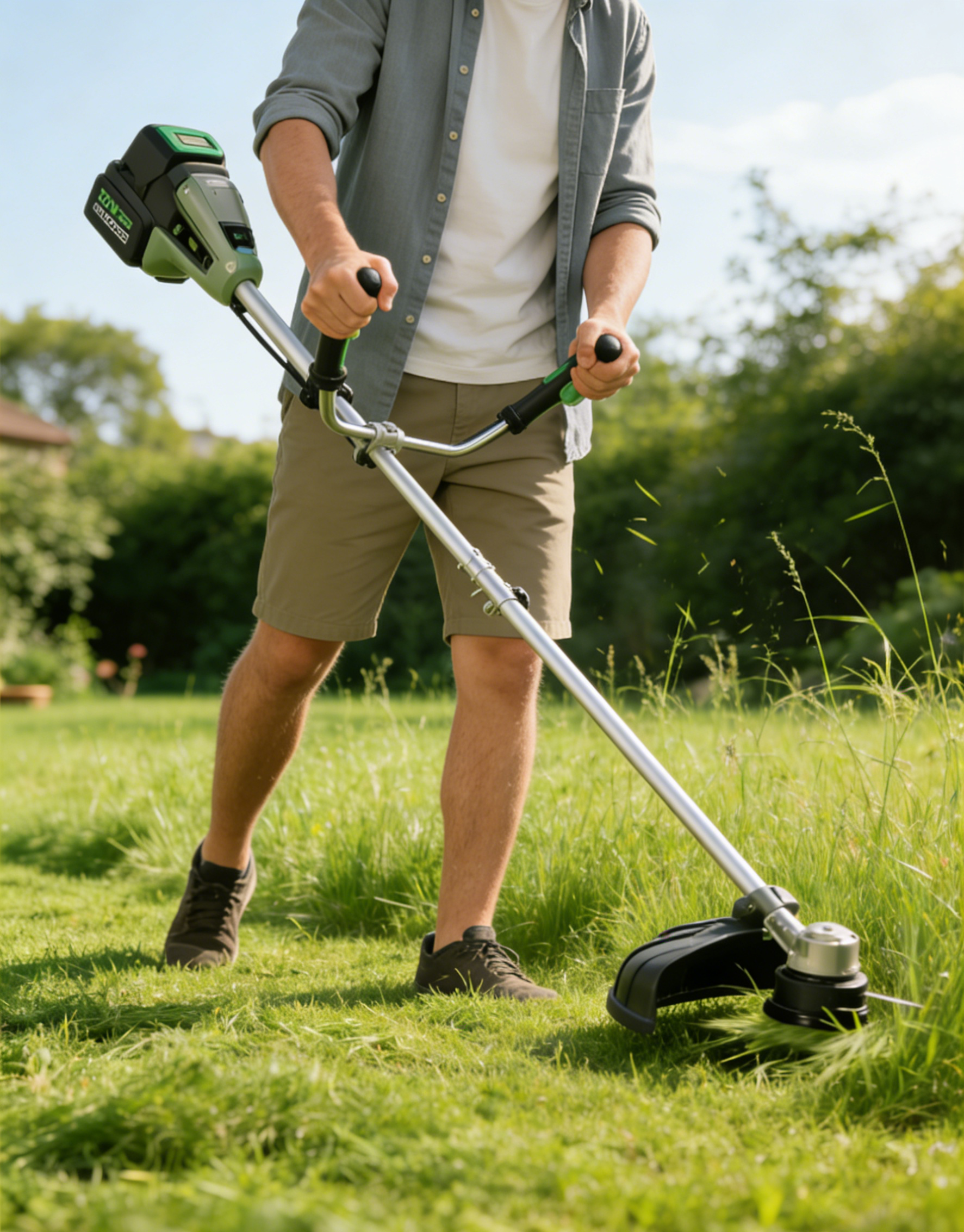
Part One: The Cordless Advantage Across All Applications
Before diving into specific use cases, it's worth understanding why cordless trimmers have become so compelling for virtually every user segment.
The Universal Benefits
| Benefit | Why It Matters |
|---|---|
| Zero Emissions | No fumes, no fuel mixing—better for operators and the environment |
| Instant Start | Push-button operation eliminates pull-cord frustration |
| Reduced Maintenance | No spark plugs, air filters, or carburetor adjustments |
| Quieter Operation | Significantly lower noise levels—ideal for noise-sensitive areas |
| Lighter Weight | Less fatigue during extended use |
These advantages apply whether you're trimming a postage-stamp city lawn or maintaining a multi-acre commercial property. The key is matching the right platform to the specific demands of the job.
Part Two: Residential Applications – Where Precision Meets Convenience
Small Yards and City Gardens
For homeowners with modest properties—typically under 1/8 acre—the priorities are maneuverability, ease of use, and storage convenience.
The Ideal Match: 12V to 40V platforms
What to Look For:
- Lightweight design (under 5 lbs with battery) for easy handling
- Compact storage – folding shafts are a major plus
- Quick-start operation – no fuel mixing or pull cords
- Adjustable cutting heads for precise edging along sidewalks and flower beds
The Makita UR100D exemplifies this category perfectly. At just 1.9-2.1 kg and featuring a telescoping shaft that adjusts from 84 to 119 cm, it's designed for comfortable operation in tight spaces . Its compact size and foldable front grip make it easy to store in small sheds or even car trunks .
Key Features for Residential Users:
- Soft-start technology eliminates startup shock
- Wire guards protect fences and ornaments
- Lock-off buttons prevent accidental startup
- Low noise levels (just 74 dB(A)) keep neighbors happy
Suburban Lawns
Moving up to medium-sized properties (1/8 to 1/4 acre), users need more power and runtime while still valuing convenience.
The Ideal Match: 40V to 60V platforms
These mid-range platforms offer:
- 30-50 minutes of runtime—enough for most suburban lots
- Brushless motors for efficiency and durability
- Balanced weight distribution for fatigue-free operation
- Tool system compatibility (batteries work across multiple tools)
The DeWalt DCMST561N-XJ, with its 18V platform (part of the XR system), delivers up to 40 minutes of runtime with a 5Ah battery and features a 33-36 cm cutting swath—plenty for efficient suburban lawn maintenance . Its folding shaft design makes transport and storage effortless .
Part Three: Commercial Applications – Power, Runtime, and Durability
The professional landscape market has been slower to embrace cordless technology—and for good reason. Commercial crews demand tools that can run for hours, withstand daily abuse, and deliver gas-comparable power. But recent advances have changed the equation.
Light Commercial – Residential Contractors and Maintenance Crews
For crews maintaining multiple residential properties daily, reliability and runtime are paramount.
The Ideal Match: 60V to 80V platforms
The Greenworks 80V platform, for example, delivers professional-grade power with 45-60 minutes of runtime under load—enough for several properties between battery swaps . Brushless motor technology ensures maximum efficiency and long-term durability .
Commercial-Grade Features:
- Extended runtime (45-60+ minutes)
- Rapid charging capabilities for quick turnarounds
- Rugged construction for daily use
- Weather-resistant designs
The Stihl FSA 135 R represents the new generation of professional cordless trimmers. With a no-load speed of 5,900 RPM and a 16.5-inch cutting swath, it matches the performance of Stihl's 28.3cc gas models . Runtime ranges from 25-45 minutes with an AP 300 battery, and it accepts both grass-cutting blades and brush knives for heavier growth .
"Weight is a consideration—the FSA 135 R weighs 11.4 pounds bare, or 15.5 pounds with the larger AP 500 battery," notes Pro Tool Reviews. "But ergonomically, it feels very similar to gas models and has very neutral weighting with the battery in place" .
Heavy Commercial – Large Properties and Municipal Accounts
For maintaining parks, golf courses, and large institutional grounds, commercial crews need maximum power and runtime.
The Ideal Match: 80V+ platforms and multi-battery systems
The EGO Professional-X line is engineered specifically for grounds maintenance teams, with tools designed for all-day, every-day use . Features include:
- Constant speed control for consistent trimming
- Free-rotating bump caps that won't wear out on the ground
- ARC Lithium™ battery technology for petrol-comparable performance
- Reduced vibration for operator comfort
Milwaukee's M18™ system takes a different approach, offering two-speed variable triggers (up to 6,200 RPM) and adjustable cutting swaths (35-40 cm) that let operators balance runtime and power as needed . The system reaches full throttle in under one second for maximum productivity .
Specialty Commercial – Challenging Terrain and Vegetation
Some commercial applications demand even more specialized solutions. ECHO's attachment-capable trimmers, for instance, can convert from standard trimming to brush cutting, cultivation, or edging—all with the same powerhead .
For the most demanding vegetation management, cordless technology has even spawned entirely new categories. Vigorun Tech's track-mounted grass trimming machines offer remote operation from up to 200 meters away, with adjustable cutting heights and 6 km/h travel speed—ideal for road slopes, embankments, and tall reeds .
Part Four: Decision Framework – Matching the Tool to the Task
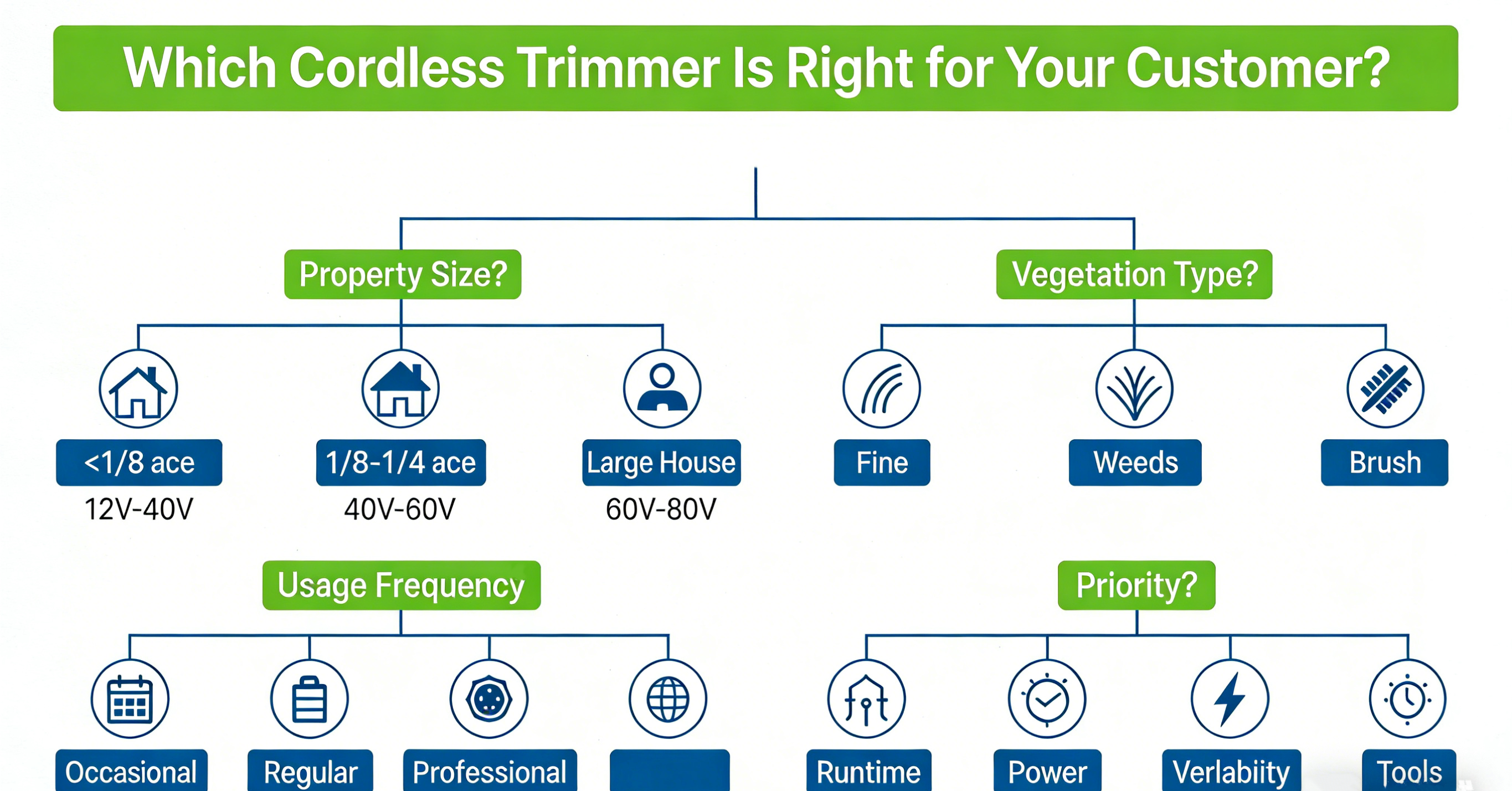
For distributors helping customers select the right cordless trimmer, this simple framework can guide the conversation:
Question 1: What's the Property Size and Terrain?
| Property Type | Typical Size | Recommended Platform | Runtime Needed |
|---|---|---|---|
| Small residential / Townhouse | Under 1/8 acre | 12V-40V | 20-30 minutes |
| Suburban lot | 1/8 - 1/4 acre | 40V-60V | 30-50 minutes |
| Large residential / Small commercial | 1/4 - 1 acre | 60V-80V | 45-60+ minutes |
| Commercial / Municipal | 1+ acres | 80V+ / Multi-battery | 60+ minutes (multiple batteries) |
Question 2: What Type of Vegetation?
| Vegetation Type | Recommended Features | Example Applications |
|---|---|---|
| Fine grass, lawn edges | Standard trimmer line | Residential lawns, edging |
| Thick grass, light weeds | Twisted or dual-line, higher power | Overgrown lots, fields |
| Heavy brush, saplings | Blade-capable, maximum torque | Right-of-way maintenance, rough terrain |
Question 3: What's the Usage Pattern?
| Usage Frequency | Priority | Best Choice |
|---|---|---|
| Occasional (weekly) | Ease of use, storage | Lightweight platform with folding shaft |
| Regular (daily) | Reliability, runtime | Mid-range platform with multiple batteries |
| Professional (continuous) | Durability, power | Commercial-grade platform with rapid charging |
Fig.4: Decision tree infographic helping users select the right cordless trimmer based on property size, vegetation type, and usage frequency.
Part Five: Maximizing Value – The Platform Approach
One of the most compelling arguments for cordless equipment—for both residential and commercial users—is the platform ecosystem.
Why Platform Matters
When customers invest in a battery platform, they're not just buying a trimmer. They're buying into a system that can power:
- Leaf blowers and vacuums
- Hedge trimmers and pruning shears
- Chainsaws and pole saws
- Lawn mowers and cultivators
- Even workshop tools like drills and circular saws
This compatibility delivers enormous value:
- Lower long-term costs – one battery and charger serves multiple tools
- Reduced storage requirements – no separate fuel systems for each tool
- Simplified maintenance – consistent care across the fleet
- Future-proofing – new tools integrate with existing batteries
For Distributors: The Upsell Opportunity
The platform approach creates natural upsell opportunities. A customer buying a trimmer today is likely to return for:
- Additional batteries – for extended runtime
- Rapid chargers – for quick turnarounds
- Complementary tools – blowers, chainsaws, etc.
- Seasonal accessories – edger attachments, brush blades
- Consumables – trimmer line, replacement spools
Part Six: Real-World Performance Data
Runtime Expectations
Based on manufacturer data and independent testing, here's what users can expect:
| Platform | Typical Runtime | Battery Capacity | Load Conditions |
|---|---|---|---|
| 12V (Makita) | 38-55 minutes | BL1041B | No load |
| 18V (DeWalt) | 40 minutes | 5Ah | Mixed use |
| 36V (Stihl) | 25-45 minutes | AP 300 | Under load |
| 80V (Greenworks) | 45-60 minutes | 2-4Ah | Heavy use |
Power Comparison
Modern cordless trimmers deliver impressive power metrics:
- Makita DUR193Z: 280W max output, 7,800 min⁻¹ no-load speed
- Stihl FSA 135 R: 5,900 RPM, matches 28.3cc gas performance
- Milwaukee M18: 6,200 RPM top speed, full throttle in under 1 second
Weight Considerations
Weight varies significantly by platform and battery choice:
- Light residential: 1.9-2.1 kg (Makita UR100D)
- Mid-range: ~5 kg bare (DeWalt DCMST561)
- Commercial: 5.2-7 kg with battery (Stihl FSA 135 R)
Part Seven: Maintenance and Longevity
One of cordless trimmers' greatest advantages is dramatically reduced maintenance compared to gas equipment .
What's Eliminated
- No fuel mixing or stabilizer
- No spark plug replacement
- No air filter cleaning
- No carburetor adjustments
- No exhaust system maintenance
What Remains
- Cleaning after each use
- Checking and replacing trimmer line as needed
- Inspecting battery contacts
- Proper storage (dry location, moderate temperatures)
With proper care, lithium-ion batteries typically last 3+ years of regular use .
Conclusion: One Technology, Endless Applications
Cordless string trimmers have truly come of age. They've evolved from underpowered curiosities into legitimate alternatives—and often superior choices—for every segment of the market:
For residential users, they offer convenience, quiet operation, and freedom from the hassles of gas engines. Whether maintaining a small city garden or a suburban lawn, there's a cordless platform perfectly matched to the task.
For commercial operators, today's high-voltage systems deliver the power, runtime, and durability needed for professional use. With performance matching gas equivalents and significantly lower operating costs, they represent a compelling business case.
For specialty applications, cordless technology enables solutions—like remote-controlled slope mowers—that weren't possible with traditional equipment.
At Hantechn, our comprehensive range of cordless outdoor power equipment spans the full spectrum from 3.6V to 80V platforms [citation:URL]. Whether your customers are homeowners with modest lawns or commercial crews managing large properties, we have the solutions they need to work efficiently, sustainably, and profitably.
The cordless revolution isn't coming—it's already here. And it's making every trimming job, from the smallest residential edge to the largest commercial property, easier, cleaner, and more productive than ever before.
Frequently Asked Questions
Q: How long do cordless trimmer batteries typically last?
A: With proper care, batteries can last 3+ years of regular use . Runtime per charge varies by platform, typically 30-60 minutes of continuous operation .
Q: Can cordless trimmers really match gas power?
A: Yes. Professional platforms like Stihl's FSA 135 R match the performance of 28.3cc gas trimmers , and high-voltage systems (80V+) deliver comparable power for heavy applications .
Q: What's the best voltage for my needs?
A: For small residential yards, 12V-40V works well. For medium to large properties, 40V-60V offers the best balance. For commercial use, 60V-80V+ platforms provide maximum power and runtime .
Q: Can I use the same battery across multiple tools?
A: Yes! That's one of the key advantages of cordless platforms. All tools within the same voltage family from a manufacturer typically share batteries .
Q: Are cordless trimmers weather-resistant?
A: Many professional-grade models feature weather-resistant designs. Makita's XPT (eXtreme Protection Technology) and similar systems from other manufacturers provide improved dust and water resistance .
Q: What maintenance do cordless trimmers require?
A: Much less than gas! Clean after each use, check trimmer line, inspect battery contacts, and store properly. No fuel mixing, spark plugs, or carburetor adjustments needed .
Post time: Mar-06-2026